
Athens City Directory Shelves
Athens city directories sit in three places. UGA MAGIL catalogs Georgia directories under several publisher records, Hargrett Rare Books holds volumes printed before 1900, and the Athens Regional Library Heritage Room offers staffed local-history help. For online use, the Digital Library of Georgia carries the verified Athens span.
| Collection | Years | Where Held | Access |
|---|---|---|---|
| Digitized Athens directories | 1889-1958 span | Digital Library of Georgia | Free online scans; selected CSV data |
| Georgia city directories | Multiple catalog runs; verified Athens shelf volumes | UGA MAGIL | Catalog and onsite use |
| Pre-1900 directories | Early Athens volumes | UGA Hargrett Rare Books | Reading-room request |
| Local directory and microfilm holdings | Catalog-specific; not a proven continuous run | Athens Heritage Room | Noncirculating onsite or reference service |
DLG offers residential CSV extracts covering 1889, 1897-1898, 1904, and 1926-1927. No one has established when the last printed Athens directory appeared. Rather than assume an unbroken run, ask the libraries about the particular year you need.
UGA Holds Athens Directory Runs
The UGA city-directory guide warns that the holdings sit under multiple publisher records, so a catalog search built around one company can miss an Athens city directory from the same decade issued by another.
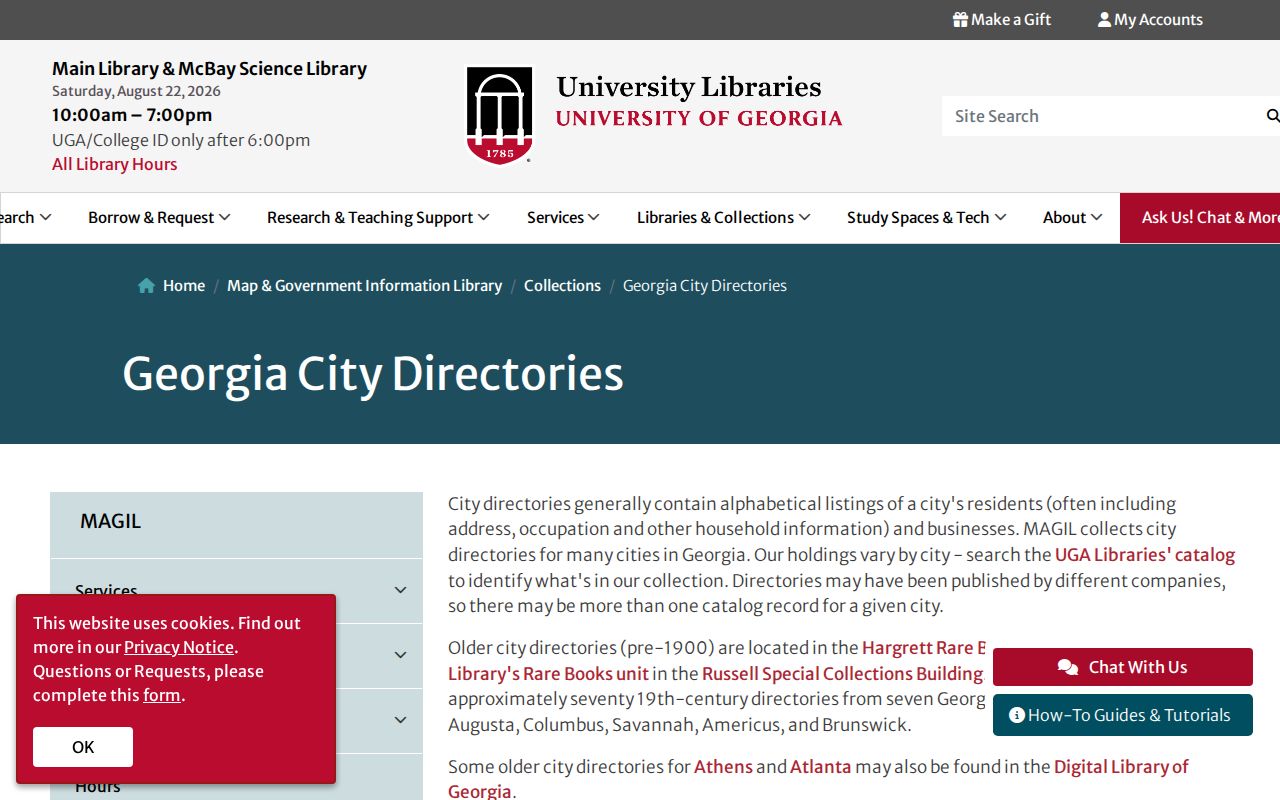
Volumes from before 1900 route to Hargrett Rare Books, while later map-and-government holdings go to MAGIL. Include the year and publisher with every request. That detail speeds the retrieval.
Athens Directory Publishers by Year
The digitized sequence names M. C. Pope & Co. in 1889 and Valentine W. Skiff in 1894. W. G. & M. E. R. Finney issued the 1897-1898 volume. The Athens Banner printed the 1904 edition. A 1909 volume and the 1920-1921 directory follow, and Nelsons' Baldwin editions appear later. Confirmed specimens include 1954 and 1956. Shifting publishers explain why one search term cannot recover the whole shelf.
| 1889 | M. C. Pope & Co. edition in the DLG collection |
|---|---|
| 1894 | Valentine W. Skiff edition |
| 1897-1898 | W. G. & M. E. R. Finney edition and CSV extract |
| 1904 | Athens Banner edition and CSV extract |
| 1926-1927 | Residential CSV extract available |
| 1954 and 1956 | Verified local volumes used in the Bell's case study |
This is a verified timeline, not a list of every issue ever printed.
Decode an Athens Directory Entry
An alphabetical Athens city directory entry can list a surname, given name or initial, spouse, occupation, firm, and street address. Publisher practice varied. Copy each entry exactly as printed, and check that volume's front matter before expanding any mark.
| Name | Surname, given name or initial; spouse may appear in parentheses |
|---|---|
| Occupation | Position and sometimes the employer |
| Address | House number and street for the publication year |
| Household mark | Owner, renter, or householder symbols only when defined in that key |
| Widow notation | “Wid” may identify a deceased spouse |
- Criss-cross directory
- A street-order section that reverses the usual surname lookup.
- Householder index
- A list organized around the named adult tied to a household entry.
- Abbreviation key
- The publisher's legend for symbols and shortened terms; capture it before transcribing entries.
One 1954 master edition states it covers residents age 16 and older. Its entries can add spouse, dependents under 16, ownership, position, employer, and home address. That inventory belongs to that edition alone, not to every Athens book on the shelf.
Athens Heritage Room Access
The Heritage Room is staffed and noncirculating. Visitors sign in and store items as required. Cameras without flash and personal scanners are permitted. No library card is needed for onsite work. A free 45-minute consultation can pin down call numbers and likely sources. Deeper research starts after that. The Heritage Room reference service also handles paid research beyond that consultation. It costs $15 per hour for Georgia residents and $25 per hour for everyone else. UGA generally points remote researchers toward independent help instead, so treat these channels as distinct. These are separate channels.
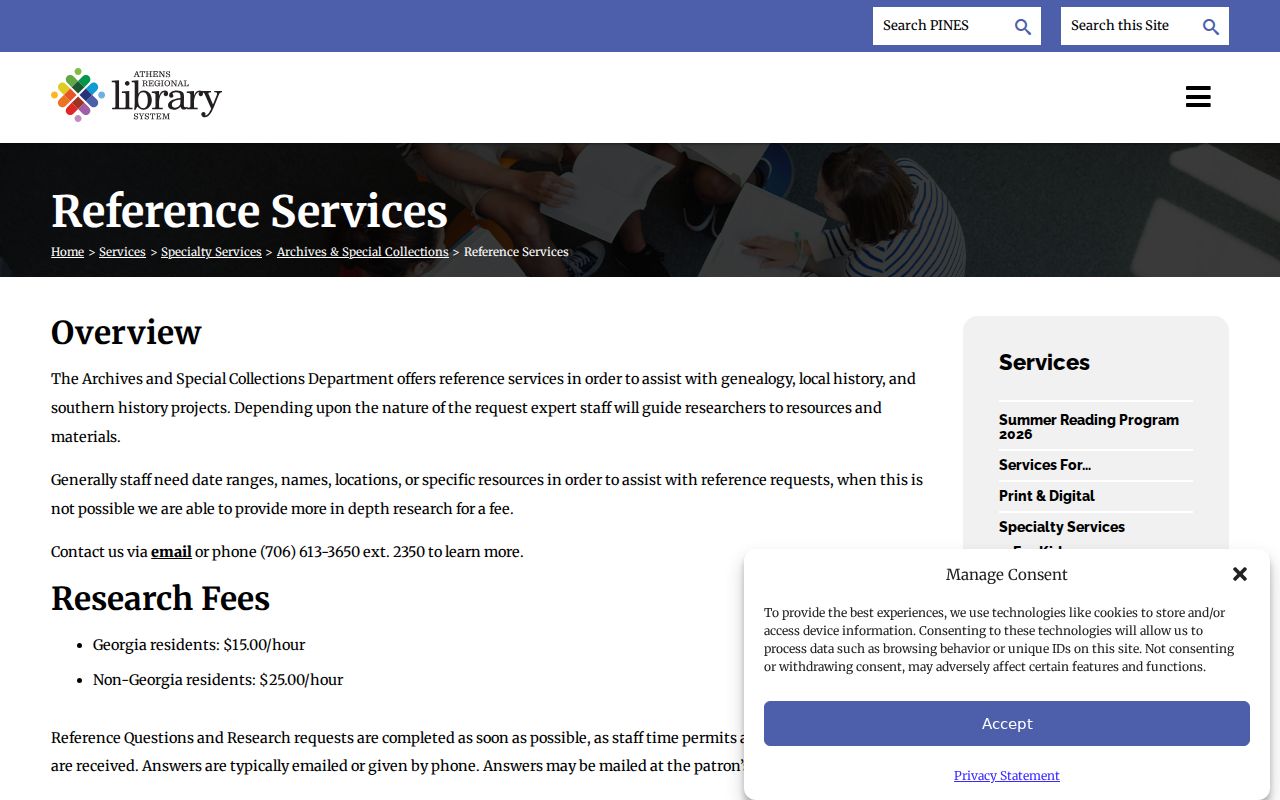
The service earns its keep when a needed Athens directory exists only on paper. It also helps when microfilm and vertical files must be searched together.
Bell's Move Through Athens Records
A Heritage Room case study proves the snapshot problem. The 1954 edition placed Bell's at 294 W. Washington. The 1956 volume put it at 1237 Prince Avenue. Newspaper advertisements narrowed the move to that interval and contradicted a later company history claiming 1957. The sound method is to bracket an event between two editions, then hunt for a dated notice, advertisement, deed, or permit. A publication year never reveals when canvassing occurred. So it cannot prove an exact move date on its own.
Find Athens Streets in Reverse
Later Athens city directories may include a numerical householders' street guide. The 1954 master edition does, alongside alphabetical resident, business, and numerical telephone sections. A reverse search starts at the street heading and moves to the house number. It then records the listed occupant and telephone exactly as printed. Never assume every volume has a criss-cross section. Inspect the contents first. When an address jumps, compare adjacent years. Also compare the directory street guide, the Sanborn map index, and city plans. Current parcel and deed work belongs in the Athens street directory by address instead.
Athens Directories Meet Maps
UGA's Athens Sanborn holdings span 1885, 1888, 1893, 1898, 1903, 1908, 1913, 1918, and 1926. A 1926 set was updated to 1967. The series grew from four sheets in 1885 to 44 in 1926. That expansion makes it a strong geographic companion to city directory addresses. Georgia Historic Newspapers adds advertisements, obituaries, moves, and public notices. The Digital Library of Georgia adds more of the same. Search surname variants, then browse nearby issue pages, because OCR often fails on small type. UGA's Athens City records, 1860-1970, contribute maps, plats, plans, and engineering context. They help when a modern number will not match an old listing.
Georgia Archives Extend Athens Research
The Georgia Archives Virtual Vault allows a no-login search across digitized historical collections and microfilm indexes. Search Clarke County as well as Athens. Deeds, probate, and many court records keep the county label even after city-county unification.
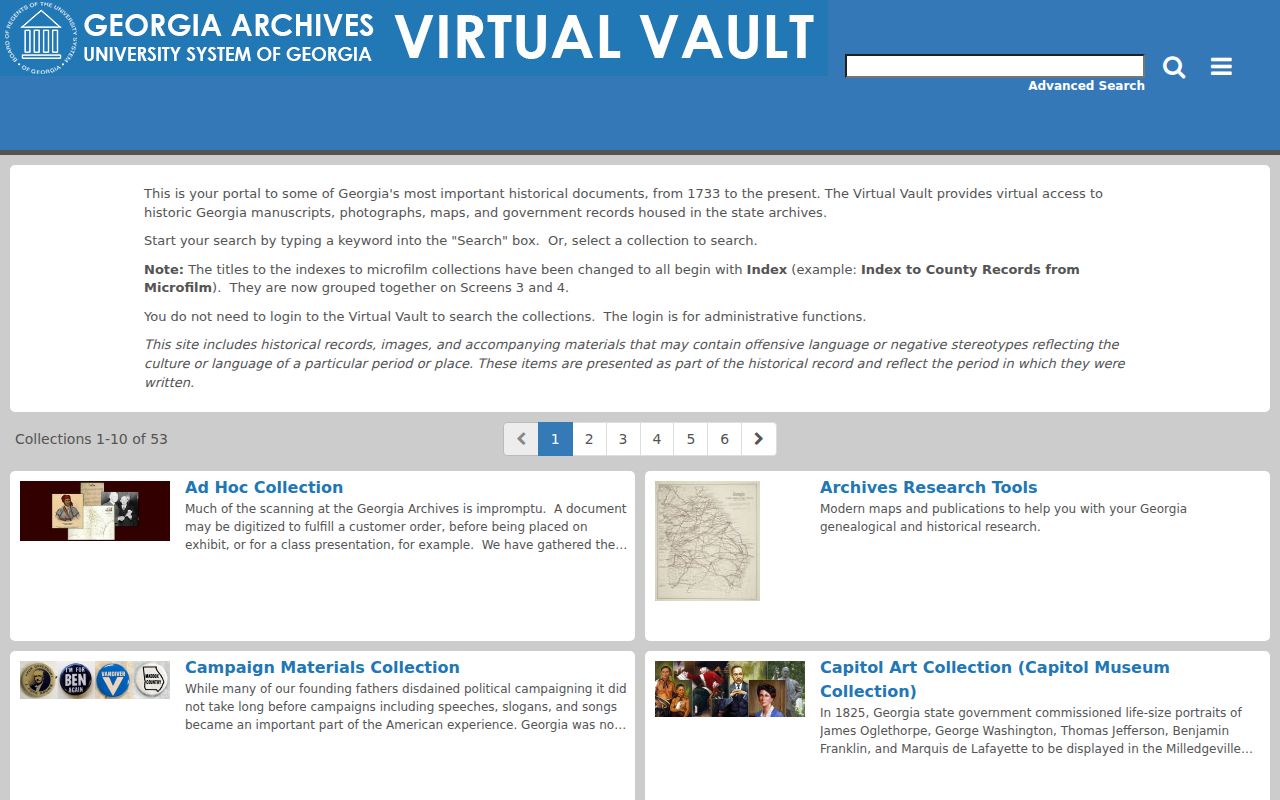
Archive results supply the county and record context that gives a directory name its meaning. The original volume still controls the wording, though.
Trace Families in Athens Directories
Start with the newest federal census schedule for Athens. Then work through the city directory one year at a time. A census captures a household on a single night. A directory can fill the quiet years between census dates. That makes it a natural partner for tracing an Athens family across decades. Just remember what a directory misses: children, boarders, rural residents, and anyone who went unlisted.
- Begin with the 1950 census or another known date. Record names, ages, occupations, and the exact address.
- Open the nearest Athens volume. Search surname variants and initials, then copy spouse, work, and address fields.
- Move forward and backward by edition. Log first and last appearances without converting them into exact move dates.
- Check the reverse section, when present, for the address and replacement listing.
- Use newspapers, probate, obituaries, cemetery ledgers, deeds, and the next census to explain the change.
When a name drops out of a directory, treat the disappearance as a question rather than an answer. A move could explain it. So could a death, a missed canvass, or a new listing choice. A gap in the collection might be the cause too. Oconee Hill Cemetery records, 1897-2015, can close the trail of a person who died in Athens. Probate files can close it as well. For students, whose ties to the city may be brief, yearbooks and UGA publications often fill the gap.